
Butte County Arrest to Court Records
A Butte County arrest begins with law enforcement action, but the public court record begins only after the case reaches the court filing stage. If the person is taken to the local jail, booking is handled by the Butte County Sheriff's Office at 256 W. Grand Ave. in Arco. That office can address custody and jail booking questions. The court case is separate. The Butte County courthouse at 326 W. Grand Avenue, P.O. Box 171, Arco, ID 83213, phone (208) 527-8259, is the local route for case records and hearing questions. The listed local court contact is Shelbi Carey at scarey@butte.idcourts.gov.
For court records after a jail arrest, the key question is what the prosecutor filed. Idaho counties use the term prosecuting attorney. Butte County Prosecutor Steve Stephens is listed at 221 W. Grand Ave., P.O. Box 736, Arco, ID 83213, phone (208) 527-3458, email prosecutor@buttecountyid.us. Candy Bragg is listed as legal assistant. The prosecutor's charging decision may match the booking charge, but it may also narrow, add, amend, or decline charges. For custody and booking detail, use Butte County jail inmate records. For booking photos, use Butte County jail mugshots.
Butte County iCourt Case Search
Public criminal case information for Butte County is searched through Idaho iCourt and its Smart Search tools. The portal is a court-record system. It does not prove that a person is still in the Butte County Jail, and it does not replace a call to the sheriff for current custody. It can show the filed case, party names, case status, public docket entries, charges, hearing events, and payments where those records are public and entered.
The iCourt portal screenshot in the manifest shows the statewide entry point for Smart Search, hearing search, payments, and public notices at the Idaho court portal.
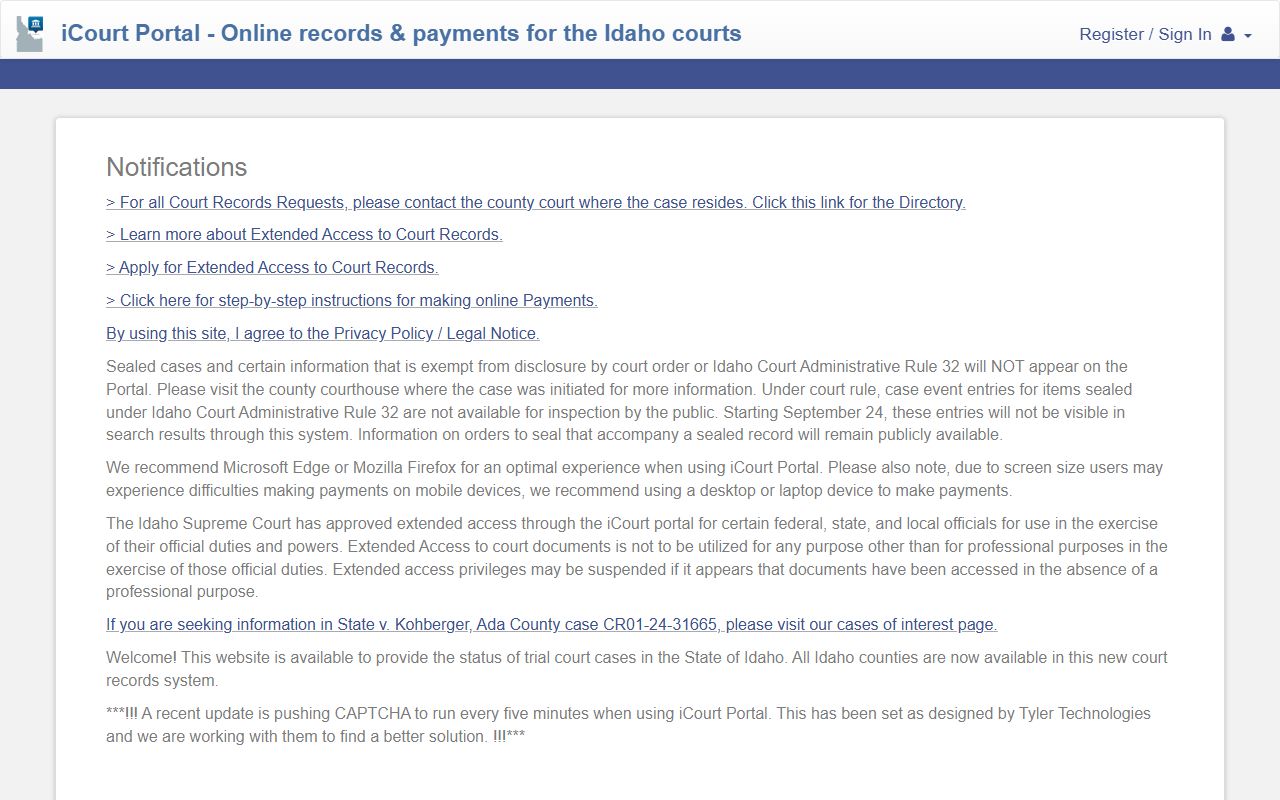
Use the court portal for filed charges and hearing dates, then use the courthouse phone number when a public result is incomplete, confusing, sealed, or not yet visible.
| iCourt Field | How It Helps After Arrest |
|---|---|
| Record Number or Name | Search by case number or by name in Last, First Middle Suffix format. |
| Last, First, Middle, Suffix | Use separate name fields for a more precise party search. |
| Location | Filter to Butte County when the arrest and case are local. |
| Search Type | Party Name, Nickname, Business Name, and Sounds Like help with name variants. |
| Include | Cases and Protection Orders can be selected where relevant. |
| Phone, FBI, SO, Booking Number | Optional filters can narrow a result when known. |
| Case Type, Status, File Date, Judicial Officer | Advanced filters help distinguish active criminal cases from older or unrelated results. |
Butte County Hearing Records
Hearing dates can be searched separately through iCourt Search Hearings. This matters after a recent arrest because a hearing may be scheduled while the reader is still trying to identify the case number. Idaho Criminal Rule 5 requires a defendant arrested without a warrant to be taken before a magistrate without unreasonable delay and no later than 24 hours after arrest, excluding Saturdays, Sundays, and holidays. That first court event is often where rights, counsel, bail, and the next setting are addressed.
| Hearing Field | Butte County Use |
|---|---|
| Location | Select Butte County from the Idaho county list. |
| Hearing Types | Butte choices include All Hearing Types, Civil, Criminal, Family, and Probate or Mental Health. |
| Search Types | Case Number, Party Name, Business Name, Attorney Name, Attorney Bar Number, Judicial Officer, or Courtroom. |
| Sounds Like | Use for phonetic name variants when spelling is uncertain. |
| Name Fields | Last, first, and middle name fields support party-name searches. |
| Judicial Officer and Date Range | Narrow results by officer and hearing dates, then clear filters when starting over. |
Note: A missing hearing result is not proof that no Butte County arrest occurred, especially before filing or when records are restricted.
Butte County Charging Records
The charging document is the bridge between a jail arrest and the court case. A sheriff or officer may list an arrest basis during booking, but the prosecutor decides which formal charge or charges to file. A filing date can differ from an arrest date. The charge level can also change as facts are reviewed, witnesses are contacted, or plea negotiations begin.
| Document | Who Uses It | What It Means |
|---|---|---|
| Complaint | Officer or prosecutor | Often begins a criminal case after arrest and states the alleged offense. |
| Information | Prosecutor | A formal prosecutor-filed charging document, often used in felony practice after required proceedings. |
| Indictment | Grand jury | A grand-jury charging document. It is possible, but less common in routine local arrest workflow. |
When comparing jail and court records after an arrest, treat the court filing as the better source for what is being prosecuted. Treat the jail record as the better source for custody, intake, release, and transfer facts.
Butte County Charge Status
Charge status is the part of the court record that shows where each allegation stands. A single case can contain more than one count. One count may be dismissed while another remains pending. The public iCourt result may show enough status detail for a basic lookup, but certified copies, older files, or restricted docket entries may require contact with the courthouse.
| Status | Plain Meaning |
|---|---|
| Pending | The charge has been filed and has not reached final disposition. |
| Amended | The charge wording, level, count, or code has been changed by later filing or court action. |
| Reduced | The charge has been lowered to a lesser offense or level. |
| Dismissed | The charge is no longer being pursued in that case, subject to the exact court order. |
| Disposition | The current or final outcome, such as plea, conviction, acquittal, sentence, or dismissal. |
Bond After Butte County Arrest
Bond and release decisions are tied to the court case, the sheriff's custody authority, and any hold from another agency. The Idaho Bail Act, Title 19 Chapter 29, covers recognizance release, bail, bail bonds, sureties, cash deposits, property bonds, forfeiture, revocation, and exoneration. A recognizance release means the court releases the defendant based on a promise to appear and comply with conditions. A surety bond is backed by a bail agent or surety. A detainer or hold is a separate authority that can block release even if one case appears to have bail.
- Call the Butte County Sheriff's Office at (208) 527-8553 ext. 0 to confirm custody and ask whether release can be handled locally.
- Call the courthouse at (208) 527-8259 for the case number, court-set bail amount, hearing status, and payment direction.
- Use iCourt Make Payments only where that case and payment type are supported.
- Ask whether another warrant, probation issue, IDOC matter, federal hold, immigration hold, or out-of-county case prevents release.
Warrants and Court Records
No official Butte County active warrant search was located in the research. Warrant checks should use the sheriff, courthouse, iCourt case search, and iCourt hearing search. An arrest warrant authorizes arrest before the first appearance or based on a complaint and probable cause. A bench warrant usually follows a prior court appearance and may be tied to failure to appear, a release violation, or a probation issue. A search warrant authorizes a search, not jail custody by itself.
Idaho Court Administrative Rule 32 limits public access to some warrant materials. Unreturned arrest warrants, except bench warrants, and affidavits or sworn testimony supporting search or arrest warrants while pending return may be exempt. That means a public search can miss restricted warrant material even when lawful action exists.
Charges, Convictions, and Cleanup
A charge is not a conviction. That distinction matters for Butte County court records after a jail arrest because public search results may show accusations before a case is resolved. It also matters when a person asks about sealing, shielding, or criminal-history cleanup after dismissal or acquittal. Idaho State Police criminal-history processes are separate from public court search, and Idaho Code section 67-3004 supplies specific expungement and shielding concepts for criminal-history records.
| Topic | Charge | Conviction |
|---|---|---|
| Meaning | An accusation filed or listed in a court case. | A final finding after plea, verdict, or other qualifying disposition. |
| Proof Level | Based on filing standards and probable cause concepts. | Requires proof beyond a reasonable doubt or a valid plea. |
| Record Use | Must be read with status and disposition. | May affect sentencing, supervision, and criminal history. |
| Topic | Sealed | Expunged or Shielded |
|---|---|---|
| Public View | Hidden or restricted from ordinary public court access. | Handled through specific criminal-history cleanup rules where eligible. |
| Who May See It | Courts and authorized users may retain limited access. | Access depends on the statute, order, and record system involved. |
| How to Check | Ask the courthouse what authority is needed for access. | Use Idaho State Police and court processes, not informal web removal requests. |
Important: Court search results are not consumer reports and should not be used for FCRA-covered screening decisions.
Restricted Butte County Court Records
Public access is broad, but it is not unlimited. Idaho Code section 74-124 protects certain law-enforcement investigatory records where release would cause listed harms. ICAR 32 controls public access to Idaho judicial records. Juvenile records, victim or witness details, medical and mental-health information, confidential-source material, sealed cases, and active investigations may be withheld, redacted, or absent from public search results.
For Butte County, the practical workflow is office-specific. Call the sheriff for current custody and booking questions, use iCourt for filed cases and hearings, call the courthouse for case-record help, and treat the prosecutor as the charging office rather than the jail records counter. A missing online result is inconclusive until the right office confirms the record status.